Facebook Pinterest Instagram Email Teachers Pay Teachers Image Map

Friday, January 22, 2016

Differentiated Math

We recently had an opportunity to actually talk and share ideas with all of the other first grade teachers at the end of our half day district inservice the other day-it was amazing!  I may be a bit odd because I have always loved staff meetings, professional development, taking classes toward renewing me license etc.  I love connecting with other people in our profession and learning from each other.  It's what has always made me love this career so much.  I can never know it all.  There is always something new and ways I can improve for the benefit of my students.  To me, that is so inspiring.  What was so great, was that in this group of first grade teachers, there were so many that are looking to learn and share from each other.  We are in the process of organizing our own get togethers where we can collaborate on things that we feel would benefit us.  So exciting!

Anyways, we were sharing how we are approaching the implementation of our new math series (Go Math) and I mentioned my MATH rotations (see a post about them here).  As I have thought about some of the questions I was answering about the routine, I thought it might be helpful if I described a typical math lesson and how I differentiate. (I won't have too many pictures since this wasn't a preplanned post, but I will do another one soon and make sure to include more pictures).


My main message to these awesome ladies was that the materials in our math series are just a resource to me.  I don't allow it to dictate my lessons.  I'm still doing what I have been doing for the past several years because it's been working.  I have had to adapt things a lot as we changed from EDM to Go Math.  Yes, I use the materials, the same format as their assessments, the sequence, etc.  But the core of how I teach math remains the same.

My other main point is that differentiation doesn't need to be fancy!  I have four children of my own and sometimes feel like I'm drowning with all of the things I need to do as mom, wife, and teacher.   I pour my heart and soul into teaching, but I try to be efficient and keep things simple whenever I can.  I have read some other blog posts about guided math and I get exhausted just reading about the color coded bins and seemingly endless differentiated activities.  My MATH rotations provide differentiated instruction, but in a way that is very manageable for me which means I actually can keep up with it:)

I rely on data a lot and truly use it go guide my instruction.  My math groups change daily based on that data.  I love nothing more than getting to meet with each group and feeling like I am giving them instruction right at the level they need.  But in order to consistently meet with my groups and not get overwhelmed, I have learned to keep things simple.  My differentiated instruction certainly isn't full of cute laminated task cards (I try when I can), but I don't put too much pressure on myself that way or I would get too overwhelmed and not keep up.  So here is a peak at how one of my lesson's developed this week.

Identify the Learning Objective

We are on unit 6 in Go Math which focuses on place value.  Wednesday I planned to teach lesson 6.8 which focuses on making a model to show a number in different ways.  The common common core standard is 1. NBT.B.2a (Understand that the two digits of a two-digit number represent amounts of tens and ones.)  Our students also take the MAPS assessment to show growth and I know that there are problems where students need to identify more than one way to represent a number with place value blocks.  So this is an important lesson for sure and I knew some of my students would struggle with this skill.

Create Assessments

Creating assessments is usually my first task.  For Go Math, we give the chapter tests for a summative assessment.  I create my own diagnostic, formative, and summative assessments in addition.  I know many teachers use the review that is provided as their diagnostic.  This isn't as helpful to me because there are so many skills with typically only one question for each skill.  I find it more helpful to make my own assessments with several questions so it gives me a clearer understanding of where each student is with the skill.  Formative assessments may be simple exit slips and I sometimes use a couple of questions even right from their Go Math workbooks.  If the skill is also a common core standard then I like to have a summative assessment on that skill in addition to the chapter test.

For my lesson this week, I knew my job-share partner had created and given a diagnostic assessment and planned to use that data.  However, on the day of the lesson, I decided to also include one more quick  assessment so that their level of understanding was current.  I like to give the pretest the day prior to the lesson whenever possible.  But that's just me being probably a little over the top and doing the pretest a few days before probably wouldn't change things all that much.

Gather Materials

I then get busy gathering materials to use with my groups.  Sometimes that means I create something new, dust off something from a previous year, or search on TPT.  For this lesson, I remembered that I created a whole mini place value unit that included some task cards.  YAY! One less thing to create for me!!!  I love these task cards because there are two sets for easy differentiation (yellow or black chevron).  There are several types of questions/tasks with place value so if the "showing two ways to make a number" becomes too simple for a group, I can move on to the value of digits or expanded notation.

Since I'm usually gathering materials prior to knowing exactly where my students fall, it isn't an exact science.  However, I know that I will need to have something for all of the levels.  I make sure to have materials for the group(s) that demonstrate mastery on the pretest.  Often this means just taking a look at the second grade skills or sometimes it is just doing something more challenging with the first grade standard.  

Give the Diagnostic & Create 4 Groups

I graded their papers and sorted them into 4 groups.  Since I have less than 24 students, I always just make sure that there are never more than 6 students in a group.  If you have a larger class (I have done this with larger classes) and you just have to adjust to 7 in a group.  I tend to make my lowest group as small as possible to provide as much individual support as possible.  When I'm sorting my students into 4 groups, there are always surprises.  There were two students that normally struggle, but answered the diagnostic question perfectly.  This is why I do assessments for each lesson.  I'm not using a general performance score to group my students.  It is specific to that skill.  Sometimes I have a typically high performing student that needs more help on a certain skill.  My assessments are the way I ensure that each student is getting the instruction they need.

For this lesson I had 4 students in the very top group, 6 in the middle groups, and only 3 in my group needing some intense intervention.

Whole Class Introduction

I usually spend a few minutes as a whole group introducing the skill we are working with for the day. I tell them our focus and write the learning goal on the board.  I like to model and sometimes have students do some guided practice on their dry-erase boards.  

For this lesson, I used the Go Math online component projected on the smartboard to model this process.  Then we did 3 problems on the smartboard/dry-erase boards before moving to the rotations.

MATH Rotations

So what are the other students doing while I meet with students?

m=math facts (addition flashcards-differentiated).  Students can choose to work alone or with a partner

a=at your seats 
For today's lesson, I kept it extremely simple and assigned a  Go Math workbook page.  On this page students were given numbers and had to come up with 2 ways to show the place value blocks. To differentiate (simply!) I provided place value blocks for some students.  I have a student that I modify nearly every assignment.  For him, I wrote only 3 numbers and had him use blocks and then draw the model to represent the number one way.  He needs a lot more instruction before he is ready to show the number two ways.  

t=teacher time 

h=hands-on 
Students work on iPod Touches.  We just got a class set of Chromebooks so I'm hoping that sometimes during this station, students will log in and be able to work on skills that are more directly related to the unit we are.  

TEACHER  TIME DETAILS
I started with my highest group.  I gave them each two task cards like the ones show below.


I then introduced to them the place value block for hundreds.  I modeled this and then gave them some task cards (below) to practice.


Once the four of them seemed secure with this, I modeled how to generate two ways to draw the place value blocks and had them practice using task cards (below) to practice.


This group was doing so well and moved through these pretty quickly, so I decided to extend it just a bit more and talk about the value of each digit in a number.  I taught and modeled this concept using a task card and then gave them the last couple of minutes of our meeting time to practice this skill.  We even did a few (not on task cards) that were in the thousands.


My middle two groups were all students who on the diagnostic could give me one way to model the number, but needed more work with coming up with a second way.  During our meeting time, I explicitly taught them how to model a second way.  It was the whole "I do, we do, you do" model.  I modeled it.  Then we did a few together (I wrote on my easel while, they wrote on the dry-erase circles at the table).  And then they did some task cards on their own.  This individual practice is so helpful because I am right there to provide immediate feedback.  As they are working at their own pace, I can provide more instruction and support as needed.  These groups only worked on tens and ones and did not get the enrichment of moving to the hundreds as they highest group did.  I also take notes during the last few minutes of our meeting time about what students would benefit from some additional practice during our IE time.


The students in my lowest group showed (on the diagnostic) that they are not completely secure in showing just one way to represent the number with place value blocks.  In this group, I spent some time with them just writing two-digit numbers and identifying the ones and the tens.  We used manipulatives to represent the ones and the tens and then we moved to drawing them on the cards.  The cards I used with this group looked like the one below.


Two of the students were doing well enough with this that I was then able to work with them on how to represent the number a second way.  I worked with this group a little longer than my other groups.  I made notes to continue to work with them during IE time.

Formative Assessment

So after I met with all four math groups, I gave a quick exit slip.  After working with every student at my table, I already feel like I have a very strong understanding with where they each are in terms of the skill, but I still sometimes like to do a formal exit slip.


I took the data from the exit slips and my notes from meeting in groups and created an intervention list.  In this case there were 3 students who still needed some strong interventions and 3 students that I would need to check in with and provide some "light" interventions with.  Sometimes after meeting with all of my groups, there are more than a handful of students needing more practice.  In this case, I often will do another day of MATH rotations the following day.

So that's it.  Certainly not anything extraordinary.  But the students made great progress in this one lesson and were very engaged.  The high group oohed when I introduced the hundreds block and when I let them work on numbers in the thousands.  (I'm not joking.  That's why I love them.  Easy. To. Please.)  And on the opposite end, I was able to slow the pace way down for those in that lowest group.  They also were very engaged because I wasn't teaching beyond where they were.  I met with EVERY student in a small group.  The learning needs of the students were identified by using the assessment data.  The lesson (materials, pacing, level of support) was differentiated.  So although I mentioned I wouldn't label this lesson as extraordinary, it was a solid, typical lesson in my classroom and I feel extraordinary whenever I teach math in small groups:)  I hope the details I shared help you in some small way as you plan for your small math groups.


Saturday, January 16, 2016

Penguins!!!

This stretch of year can be the hardest.  All the excitement of the holidays are over and winter is really setting in.  So I'm trying to keep their interest (and mine!) and enthusiasm going and what better way than cute little penguins?!


There are so many penguin themed resources out there and my students were so into it that I actually carried this theme for the first two weeks back after break.  Why stop a good thing?

We started by reviewing the strategies that good readers use (what we have been learning in December) and despite two weeks off, I'm happy to report they easily remembered: ask questions, make predictions, and summarize.  Whew!  It actually stuck with them:)

We first made a list of all the things we think we know about penguins.  We talked about how this helps activate our schema.  We also made a list of questions we have about penguins.  I then partnered them up and had them choose a penguin book (my county library had tons).  I gave the students a graphic organizer for them to record summary sentences as they read.  As I walked around the room as they were working I made a note of places where students were struggling to understand a vocabulary word or the meaning of a particular section.  Later, I used these examples to introduce the 4th reciprocal teaching strategy: clarify.

We read a lot about penguins.  A lot.  They were so motivated.  I did read alouds, shared reading, partner reading, and guided reading.  During and after reading, we recorded important and interesting facts about penguins.  This is when I get so excited about teaching reading.  I love when they are authentically motivated and engaged in reading.

Are penguins a part of my curriculum?  Totally not.  But I love to use a theme like this and teach reading strategies (like ask questions, make predictions, summarize, and clarify).  I modeled these strategies and the students also had lots of opportunities to utilize them in their reading with varying levels of support.  Exploring all of these penguin books was also a great opportunity for them to utilize their knowledge of nonfiction text features.

The students wrote an informative piece using the facts and we did a fun directed drawing to display with their writing.  We do informative writing pieces quite often and they do so well with these now (but clearly we didn't edit and revise these:).


We also revisited the cubing strategy (see my Grinch post here for more details on cubing).   We used the information we learned from all of our nonfiction reading about penguins and did some higher level thinking.  I have been terrible about remembering to take pictures lately, but here is a page from the cubing activity.


Our district hired a consultant to model some research based strategies for teachers.  She did a lesson with our class so that the K-1 teachers could observe.  I felt a little bit of "affirmation" because part of her lesson involved the students arguing for or against penguins making good pets.  Kinda neat that of all the strategies and activities she ended up modeling one that I had just done.  Every so often I feel like I kinda know what I'm doing:)


You can click here to get a FREE copy of the penguin cubing sheets, graphic organizer, and writing paper that I used for the informative writing.

Next up, more cold weather connections-polar bears!

Sunday, December 20, 2015

The Grinch

I used to not really care for the Grinch until a couple of years ago when something inspired me to try a "Grinch Day" in the classroom.  (Perhaps it was the countless pins I would see making me feel like I was probably the only first grade teacher not doing a Grinch day:)  Ever since then I've been hooked.  Of course, my students love it, but there are so many learning opportunities with this book.


If you have read my previous posts, you know that I am implementing reciprocal teaching.  We have worked on predicting, asking questions, and are now summarizing.  I really like using the Grinch to summarize for two reasons.  Most students have heard the story before, so making predictions and asking questions just doesn't fit well.  And the second reason is that it forces students to focus on the details in the story and not bring in elements from the familiar movie into their summaries.

I divided my students into cooperative learning groups (low, middle, middle, high) and provided them with a paper to write their group's summaries on.  I stopped four times throughout the story and each student took a turn recording their group's summary.  Then we would share those whole class and discuss if the summaries were accurate or needed revision.

One of my students who struggles the most- (I think I mentioned him in my last post and I probably will write about him often because I pour so much effort into supporting him and making sure he experiences success that I can't help but share when I see progress!) - well for the first time ever he volunteered to be the writer for his group first.  (I was keeping things simple and would just have students volunteer to be the next writer for their group and made sure everyone got a turn).  This is a child who I modify nearly every assignment for and getting him to write independently has been challenging.  So, when his group went back to work, they worked perfectly together to come up with a summary sentence and this little boy proudly wrote and then shared it with the class.  The best part of my day (I know I am bit sappy and easy to please) was that I happened to glance over and see him and another boy (actually the "highest" reading student in my class) high five each other when he finished writing.  My heart melted.  I love my reading groups, but this is why I feel it is also important to have opportunities for other types of grouping of students.   You just never know when great things will happen!

Students wrote an opinion paragraph with the prompt: Should the Grinch grin?  We brainstormed a list of reasons on a web and the students independently wrote their paragraphs with a topic sentence, 3 details, and a closing sentence.  We've been doing a lot of these so they did this without much support.  Here are a couple of their pieces.


Instead of a construction paper Grinch, I love to do this directed drawing.  I do this with my own children when we have a Grinch Night at home.  They all love it and it doesn't take much time, just a little patience.  I also feel it actually is very good practice for listening and following directions.  Didn't they turn out so cute?!  The link for the directed drawing (not created by me) can be found here.


I didn't display these in the hallway since we were about to begin winter break.  I had them use their Grinches as the cover for the cubing activity we did.  Cubing is a MAX teaching strategy and a great activity to include higher order thinking skills.  There are so many ways to easily differentiate it as well so it can meet the needs of all of your students.   I kept it simple for the Grinch since it is our first time, but plan do it again in January with our penguin unit.  For our first go at cubing this year, I went over the activity as a whole group then had students work with their assigned partner as I went around providing support where needed.

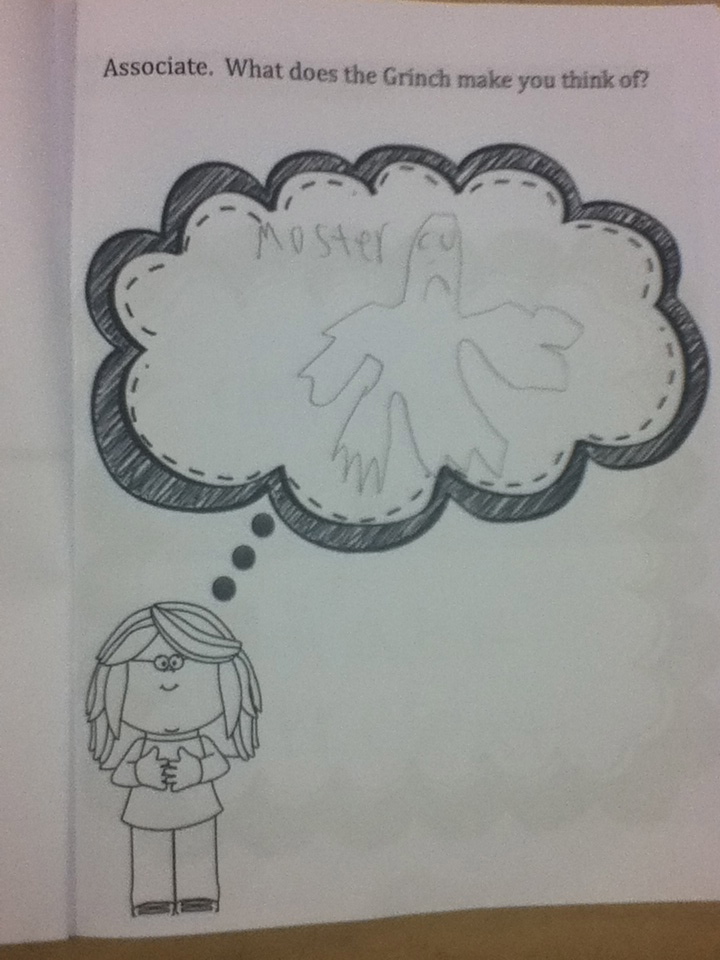
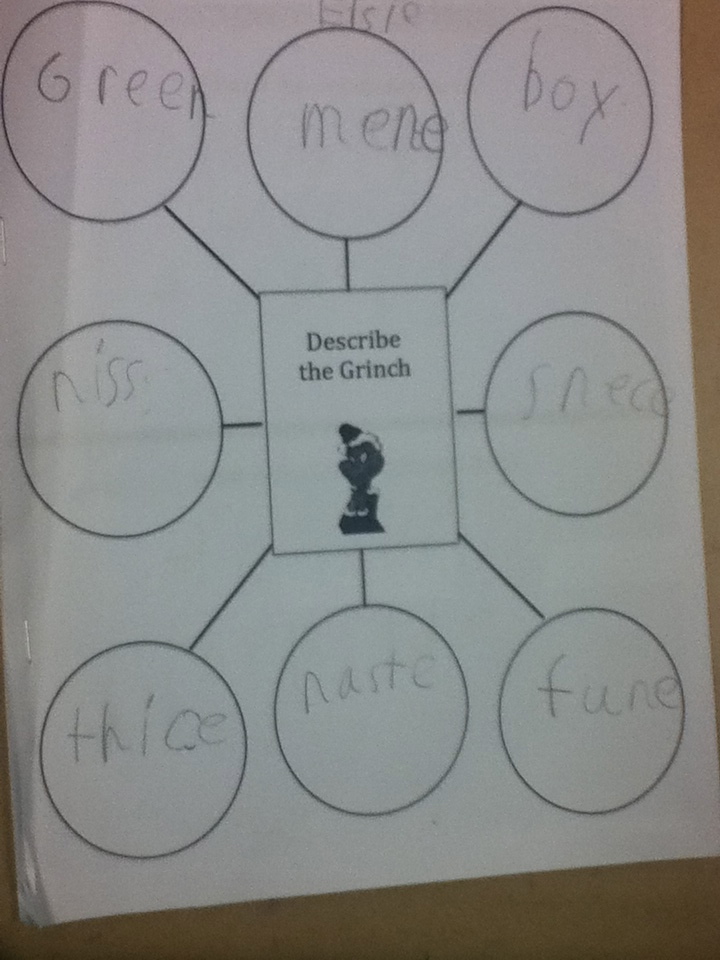
I use the cubing activity with the Grinch so students can practice analyzing a character using details from the text.  The Grinch is a great character to analyze!  Students had to describe the Grinch, compare/contrast, associate, analyze, apply, and argue for or against.  The pages I made can be found in my Grinch resource here in my TPT store.

ugly goblin

My favorite ever!  He makes me think of my brothers.  Love it!  


When we went through all 6 of the activities, I pulled up the interactive die on the smartboard.  It had each of the Bloom's levels that we used.  A student would tap the die and then pairs would share with the whole group what they came up with.  Students were allowed to revise theirs as they gained new insights from other groups.  (Again, I modified the method slightly from the official directions for cubing, but will more closely follow the format the next time.  For my first graders, I have found that doing it this way the first time helps them better understand the expectations for our next cubing activity).

And of course my principal comes in the week before winter break for my unannounced 30 minute observation!  However, I was relieved that he walked in right as we were beginning the cubing activity.  (Because you know I'm always doing a research based teaching strategy that clearly involves higher order thinking skills:)

The next day I read aloud The Smallest Gift of Christmas.  After reading the story we discussed the theme of the story and made connections to the theme in The Grinch.  We talked about the importance of making connections to the stories we read.  I shared with them how the lessons of the stories we read can stay in our hearts forever.  The students then created little books to share with their families called "What Christmas Means to Me."  Here are a few pages from their books.


This writing activity (along with the Grinch opinion writing and cubing activity) can be found in my TPT store here.


I hope you can find an idea or two to add to your Grinch activities.  I'm so looking forward to Christmas and a relaxing winter break where I can sneak in some work on my penguin unit for the first week in January!


Saturday, December 12, 2015

Elf on the Shelf!

I admit it.  I debated.  Can my class handle having an elf this year in our classroom?  Do I want to add craziness to every morning?  Isn't it nice how they come in quietly and know exactly what to do? Do I want to add a huge dose of chaos to that?  Do I really want to dish out an extra $30 at this time of year?  Is it really worth it?


YES!  Totally worth it.  

Oh my goodness, I feel embarrassed I was even debating.  Before our elf even arrived and they were grinning ear to ear as they wrote their opinion pieces about why we should adopt a classroom elf, I knew I made the right decision.  I know they are first graders and very easy to please, but every time one of my little loves comes up to me and announces that I am the best teacher in the entire world and they love school....it is worth it.  Not because I need the ego boost, but because I know that the efforts I made were worth it- if it causes them to love school.  My whole goal is to inspire a love of learning so when I have students declare they love it, I am pretty inspired.  And honestly, there are some days it is nice to get that reassurance---the days when my laundry is a mile high, dishes are in the sink, and the quilt is setting in that I should be spending time teaching my own preschooler his letters, but I am instead, creating away on my Mac for my first graders--yes, those days it is  nice to have a touch of reassurance:)

So if you are debating as I was, I encourage you to try it.  I think that if you ground it with some meaningful academic lessons and activities, you will wonder how you ever did December without an elf:)  This isn't my first year with an elf.  My job-share partner and I have done it at least twice before (we borrowed an elf from another teacher who won it).  And honestly, I have a "tougher" group this year and wasn't convinced an elf would be more of a benefit to our classroom than a distraction.  One thing that pushed me over to just go ahead and try it again was several of my past students finding me in the halls on the first day of December asking if our elf had come back.  Fifth graders (even boys) making an effort to individually find me and ask about the elf?! If it meant that much to them and created such a warm little memory in their hearts, then how could I deny that to this year's group?

But I'm "anti-fluff," so I created a few materials to bring an academic foundation to all the fun.


My Elf on the Shelf resource can be found here in my TPT store.


So here is a peak at a few of the activities we did with our elf theme this week.

I love when they are motivated to write.  I mean really motivated.  And if you tell a group of first graders (and I just happen to know this motivation easily carries through to 2nd and 4th graders because I have my own at home:) that if they can give me some very good reasons, we might just adopt an Elf on the Shelf for our classroom, their sharp little pencils won't be pointy for long.  They will write. And they will write with such determination and enthusiasm.  For them, it is an authentic writing task.  They aren't writing just another opinion paragraph because it is one of three common core writing tasks and their teacher needs to check it off her standards check-list.  No.  They feel the magic and power behind their words.  It truly means something to them.   

Here are two of my "toughest" students' pieces.  Both of these boys had squiggly marks and blank spaces on our beginning of the year letter-sound dictation.  One spent most of his kindergarden year in the school office due to behavior and the other has great difficulty attending to tasks and we modify all of his assignments.  Can you feel their motivation?!  Love it.


So students wrote an opinion piece with a topic sentence, 2-3 reasons (more if they wanted), and a closing sentence.  I did this format because it fits the first grade common core standards.  This task can be very easily adjusted to meet your grade level's writing requirements.  If persuasive writing or letter writing are in your standards, then those would work extremely well.

 Here is the graphic organizer we used to develop our reasons.


And here are two more of the opinion paragraphs.


I was very pleased with their writing.  We did share our reasons together, but the writing was done independently and the only editing was self-editing.

They were very excited when I told them I was convinced by their reasons to adopt the elf.   When our special North Pole delivery arrived, we read the story and quickly came up with a name for him so he would gain his magic.


We voted and our elf is Jack!  I have a cute bar graph (in my TPT resource) to do with my students that shows the breakdown of the voting.  I ran out of time, but still plan do this with my students next week.

Every morning, the students write down where they find Jack in their Elf Journals. This helps keep it calmer in the morning as they rush down the hallway to see where he landed (but at least they are excited to come into the classroom)!  They know they are not allowed to tell each other where Jack is each day.  Instead, they are allowed to find him, complete their regular morning routine, and write in their Elf Journal before we get started with our lessons.  These journals will make a great little memory book to take home as well.  Jack brought gummy candy canes (one on each student's desk) from the North Pole on his first morning back.  Here are a few of their first entries in their Elf Journals.


To tie in with an elf theme, we did a few other activities during the week.  In my last post, I mentioned that this month I am focusing on taking a "Reciprocal Teaching Strategy" a week to focus on.  Last week was making predictions.  This week, we added asking questions.  We did some whole class and cooperative learning activities where students wrote down their questions before, during, and after reading.  We read The Littlest Elf and Elf Help.  We continued to make predictions, but the modeling and focus was on asking questions.  We also worked with identifying the setting, characters, problem, solution, and theme in the stories.


Through our questioning, we talked a lot about the different jobs elves can have.  Our Elf on the Shelf is a scout elf.  The littlest elf tries baking, bike making, book making, and gift wrapping before discovering what job fits his strengths best.  In Elf Help, the main character also struggles with finding a role as an elf that fits his strengths.  After reading these stories, the students did some creative brainstorming about what jobs they imagine the elves to have at the North Pole.

They then very happily complete their very first job application.  Yes, no surprise-an elf application.  Although these are simple, not very time-consuming applications, the students put a lot of thought into selecting which type of elf job would be best suited to their individual strengths.  We had some great discussions and made lots of connections to the characters in the stories we read as they completed these.  I found the free elf template here that holds their application.  The application is in my elf TPT resource.  I usually like to allow students to make the construction paper elves while I'm meeting with small reading groups, but this year we just tackled it altogether and although it took a bit of our classroom time, they really enjoyed making them.


And in math, our focus is on using related facts so I couldn't think of much more than task cards with elves to tie in our theme.  But these cards were great for differentiating.  


They are part of my fact family task card set found here.  


You can read about how I use task cards and teach math in small groups in my post about Guided Math.  You can also see the other fact family task cards included in my Olive, the Other Reindeer post here.

I hope if you were debating about getting an Elf, this convinced you to give it a go!  Not only did it inspire some great learning opportunities, it is just simply magical to watch their wonder and love for our elf!


Next week, I'm so looking forward to our Grinch Day!  I'm excited to see how their "What Christmas Means to Me" mini books turn out.   This will be one of their writing responses to the Grinch and another story we read to learn the importance and power of knowing a story's theme.