Facebook Pinterest Instagram Email Teachers Pay Teachers Image Map

Wednesday, October 14, 2015

Bat Week!

I love to use bats to introduce nonfiction text features.  The students love to learn about bats, and they get so excited when they begin to find nonfiction text features during our small groups or independent reading.  I find the activity that really makes an impact on them is creating their own informative "All About Bats" book that includes some nonfiction text features.  When they are actively constructing their own examples of these features, it solidifies their understanding.  I could point out nonfiction text features all day long, but for many of my students, they won't truly begin to recognize them until they create their own example.

I started by reading an a to z reader about Bats projected on the smartboard so that we had large examples of the features to look at it.  We discussed how an author's purpose and our purpose as readers is different when reading nonfiction versus fiction.  As we read and came across a new text feature, I would add it to our anchor chart.  I tried to keep the anchor chart very simple.  I simply had the word and an example right from the book we read.  I didn't want to include a written definition because that wouldn't be meaningful or a helpful reference for first graders.


Then in small groups I guided students in finding examples of each of the features in nonfiction bat books that I got from the library.  As we found examples, we reviewed the purpose of each feature.  Later in the week, my job share partner had them read nonfiction a to z readers at their level and they had more opportunities to identify nonfiction text features.

Bold print the students found


A diagram with labels


After reading (either the read aloud, small group reading, or independent reading), the students would summarize important facts they learned about bats.  I made a list on the smart board and we added to it each day.  Students chose between 4-8 facts to include on their graphic organizers.


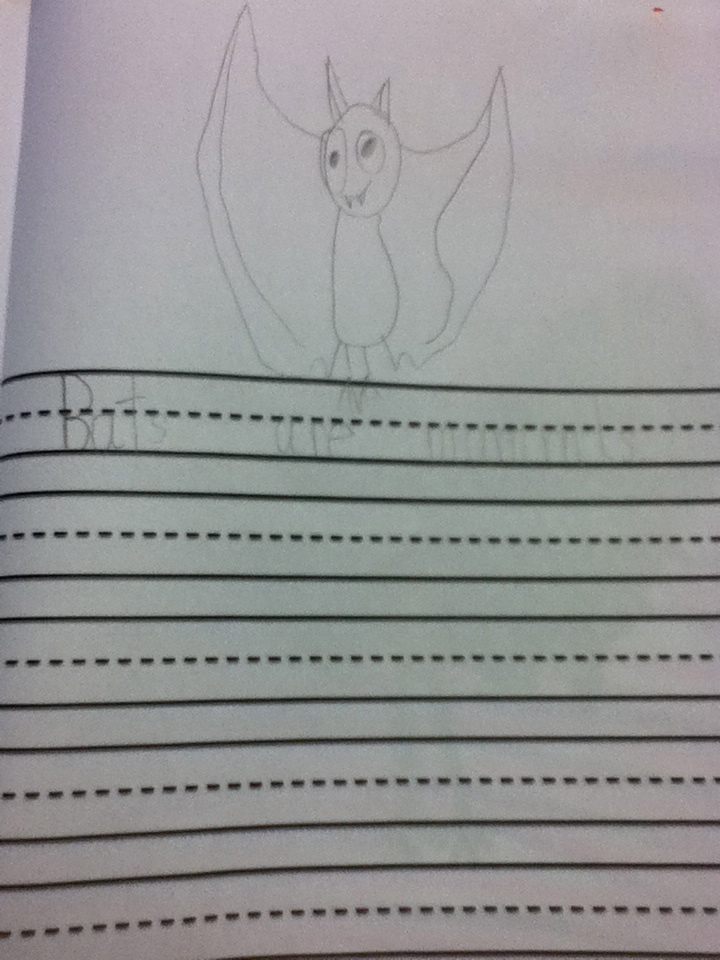
I wanted to include at least a couple of the nonfiction text features in our books.  I found a directed drawing activity, so we drew bats and then labeled them.  Their little bats turned out so cute!!  The other feature I thought would be good for them to create an example of their own is a caption.  I printed a small color picture of bats hanging upside down and the students wrote their own caption to go with it.  As the week went on, I could tell that they were definitely finding more captions and labels in their independent reading!


I considered having the students create their own Table of Contents and glossaries (with just one word), but I decided to save that for our next All About informative writing piece.  We did an awful lot with this one for the beginning of first grade!  I did provide them with a Table of Contents and they were actually quite excited about that.  I think having all of these features made them feel like true authors and I love to see them excited about that!  Here are a few pages from completed books:


You can get the graphic organizer I used in my TPT store here along with other bat writing resources. 

Next up, SPIDER WEEK!  

Friday, October 9, 2015

Informative Writing: How To

So last week was a beautiful introduction to "How To" informative writing.  Since we were official pancake chefs (compound words anchor lesson), writing an informative on how to make their favorite meal/snack seemed like a perfect piece.  I used this writing piece as a diagnostic tool.  I looked them over and made notes for myself about what skills the students were showing in their writing as well as what areas seemed to be lacking.  I used all of this to begin planning for this week's informative writing lesson.

In first grade, the common core standards have us writing three types of pieces: narrative, opinion, and informative.  I break the informative into two types: "how to" and "all about."  We also do daily journal writing as well as writing in small group in response to the text we are working with.  We are also working on incorporating writing into all content areas, and I'm specifically making an effort to do more of this in math.  (This is a new district wide goal I'm trying to get a jump start on.  A bit of a challenge for first graders, but I have been surprised with how well they are doing with it.)  Since this is our first experience this year with one of the big 3 as I call them (informative, opinion, narrative), I wanted to create a memorable anchor experience.  And now that autumn is upon us and I get obsessed with all things apple, I thought writing an informative piece on how to make applesauce would be a fitting first lesson.


I wanted to make sure I did some direct instruction and modeling with a different topic first (still an apple theme of course though.)  I read aloud a Curious George story.  In this story George gets into some mischief at an apple orchard, but in the process makes apple cider.  As we read this story we focused on two comprehension strategies: making predictions and summarizing.  As we summarized the story, we focused on the steps that George took when making the apple cider.  I then modeled writing a "How To Make Apple Cider" piece for the students.  Whenever I model writing, I take the time to act like a first grader focusing on starting each sentence with a capital letter, correctly forming my letters, using finger spaces, sounding out words, and adding end punctuation.

The next day, they were ready to tackle their own informative writing.  I wanted this to be their writing.  Not my writing in their handwriting.  It is so tempting to want to keep control and "over model" writing with these young first graders.  Although this has it's place, it's not what I wanted for this lesson.  Sometimes they just need the freedom to try!  That's why I wanted to ensure they all had an authentic experience that would provide a solid starting point from which they would be able to write.  We created an anchor chart that displayed transition words (first, then, next, finally, etc) that I wanted them to include in their writing.  As we went through the process of creating the applesauce, I posted a picture of the step (rather than us writing the sentence on the anchor chart.)  This way, when they went to write, they would still need to create their own complete sentences and could refer to the pictures for the content.

I was so happy with the level of enthusiasm they had about creating their own applesauce.  Many of them had never peeled apples with a super fancy apple peeler like I brought in:)  So of course I had to give them each a turn.  They thought the corkscrew peeled apple was the "coolest thing ever!"  After the applesauce had been cooking for a couple of hours, they were begging to take a peek.  I couldn't believe how they formed a line to each have a turn to glance and take in the aroma.  I honestly thought they would lose interest after the peeling was done.  They kept getting back in line to have another turn.  Sweetest thing.  Yes, it was fun.  Yes, it smelled amazing all day.  Yes, it was delicious. But more importantly, is provided a strong anchor for our very first informative writing.


Here are a few of their pieces!


 Here is another one.


And one more. 


I hope that you can use an idea or two about how to incorporate informative writing into what you already do!


Tuesday, October 6, 2015

The Energy Bus


I LOVE this book and its message!  If you don't know this book, I would encourage you to grab a copy and share it with your students.  This book definitely would be great for upper elementary grades as well.  Since I'm in first, I actually take several weeks to read this book.   It has such a strong, positive message that we refer to the entire year.  In the story a boy named George learns 5 rules from the Energy Bus Driver, Joy: create a positive vision, fuel your ride with positive energy, no bullies allowed, love your passengers, and enjoy the ride.  This book reminds me of a much "meatier" version of the Bucket Filler book which I also read with the class.  This is an excellent book to apply the reading comprehension strategy of making connections.

Create a Positive Vision

George learns that seeing yourself accomplishing your dreams actually can help make them come true.  I had the students think about short term and long term goals.  They drew pictures and wrote about their goals on school buses.  Here are a few of their positive visions:


Reading

Throwing basketball in the hoop

Being a vet

Exercising

Cartwheel

Be a lifeguard

Be a football player on the Browns

Be a police officer

Do a handstand

Learn how to swim

Catch the football one handed

Doing a headstand

Be a football player

A book writer when I grow up

Ride my bike no hands standing up

Catching football for a touchdown

Defeating level 99 on Lego Marvels

To be a doctor

Reading a book, learning how to swim better, be a construction worker

Play basketball

Do a handstand

Being  a lifeguard, sit with my brother on the bus when he gets older

Being a teacher, learning how to play the guitar

Being a soccer player, being a library teacher

Doing a cartwheel

Reaching level 99 on castle crasher

Kicking the soccer ball into the goal, playing basketball, playing baseball


Fuel Your Ride with Positive Energy

Next, George learns the importance of thinking positive thoughts.  I talk to my students about how it is so easy to think of all the things that we wish were different.  I could make a very long list of all the things that are bothering me or that I wish I could change.  However, that doesn't do any good!  Instead, I like to keep a list of all the things that are good in my life.  There is always something to be thankful for.  I tell them even adults need to be reminded to do this sometimes! I have each of them share something that made them happy that day.  It could be something little like siting by a friend on the bus or last year's teacher smiling and saying hello to them on their way in to school.  It could be that the cafeteria served their favorite meal for lunch today.  I give them a gratitude journal and have them complete one page with at least one specific event that has been positive for the day so far.  I encourage them to take the journals home and write in them whenever they can.  When we start looking for the positive in each day, things always seem to be better:)


 No Bullies Allowed

In the story even though George is trying to be positive, he still encounters difficulty with some bullies at school.  He learns that he has the power not to let bullies on his bus.  The book offers 3 suggestions: avoid them, walk away (after respectfully telling them to stop), and tell someone.  This is why I spend so much time reading this book.  Each one of these rules provides such great opportunities for meaningful conversations!


Love Your Passengers

This one might be my favorite.  George learns the value in spreading kindness to others.  I have each of the students write a letter to someone to say thank you or just to say something kind.  The students write to bus drivers, teachers, our custodian, their parents, friends, grandparents, recess/lunch aides, neighbors, etc.  In the website I link to at the end of this post, there are templates for students to do similar acts on a regular basis.


Enjoy the Ride

Finally, students learn about the importance of enjoying the ride.  I have them think of things that they enjoy doing and complete the graphic organizer.


Resources

Visit the Energy Bus for Kids website.  It has lots of FREE printables and ideas about how to use the book.  You can also download the pages I created for FREE here.

This book always gets me inspired and I even find myself mentally creating my vision for my future, making an effort to notice all of the positive things in my life, and reaching out to spread kindness.  Love the positive message.  Love the book.  Hope you enjoy it as well!